Published on Sept. 1, 2026
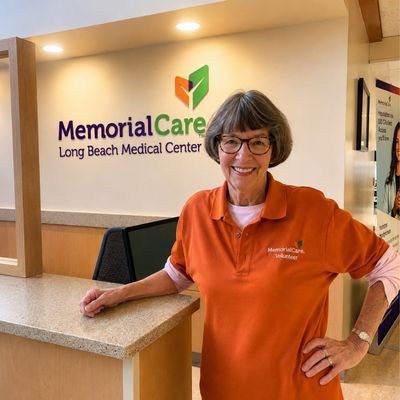
Teri Staniford has been a dedicated volunteer at MemorialCare Todd Cancer Institute at Long Beach Medical Center since 2007. Every Wednesday, she escorts visitors, delivers flowers and offers help wherever it’s needed. But in July 2020, she discovered that the care teams she had supported for nearly two decades would become the very support system she would soon rely on.
An Unexpected Discovery During a Routine Exam
During her annual wellness exam with her health care provider, Evelina Appleby, M.D., routine blood work showed an unusually high number of lymphocytes — a type of white blood cell. Dr. Appleby explained to Teri that with the elevated white blood cell count, it could potentially indicate that she may have a form of cancer, and referred Teri to Nilesh Vora, M.D., medical oncologist and medical director of the MemorialCare Todd Cancer Institute at Long Beach Medical Center. After reviewing her lab results, Dr. Vora confirmed that Teri had chronic lymphocytic leukemia (CLL).
CLL is a type of blood cancer that begins in the bone marrow and affects lymphocytes, which help the body fight infection. In CLL, the body makes too many of these cells, and they don’t function properly. Over time, the abnormal cells build up in the blood, bone marrow and lymph nodes, crowding out healthy blood cells.
Monitoring Instead of Immediate Treatment
With CLL being a slow-growing cancer, the best approach for Teri was careful monitoring. Her care team kept a close eye on her blood counts to see whether they remained stable or began to change. As long as her numbers stayed within a healthy range, there was no need for aggressive treatment, just regular follow-up appointments to ensure she was doing well. If her blood counts showed signs that the disease was progressing, that would be the signal to step in with a stronger treatment plan.
“When Teri was diagnosed, our focus was to make sure she felt safe, supported and fully informed,” said Dr. Vora. “This approach allowed us to care for Teri in the safest way possible while also helping her continue the volunteer work that means so much to her.”
For two years, Teri met with Dr. Vora every three months for routine follow-up appointments and blood work. During that time, she continued to do well. Then, in July 2022, during one of her regular visits, her care team noticed changes in her blood counts. While her white blood cell count had increased, the decision to begin treatment was driven by declines in her red blood cell and platelet counts, signaling that it was time to take a more active approach to managing her CLL.
A Turning Point: Rising Counts and Personal Loss
Now faced with the reality of treating her cancer, Teri knew she had some uphill challenges to face. What initially felt like an unexpected setback, however, was softened through the memory of Teri’s late sister.
“I honestly couldn’t believe it when I was told I needed to take a more active approach to my cancer,” said Teri. “The last two years had been, for the most part, a breeze, and I felt like I had found my rhythm. What made it even harder was the timing — just two weeks earlier, I had lost my sister after her five‑year battle with Ewing sarcoma. Having to face my own health more directly so soon after losing her was overwhelming. But in a strange way, it also felt like a reminder to take care of myself, to stay present and to keep moving forward, just like she would have wanted.”
So, Teri turned to her trusted oncologist and multidisciplinary care team to determine the best course of action for her based on her increased white blood cell count. Dr. Vora shared with Teri that she is a strong candidate for targeted therapy, which uses customized chemotherapy to treat cancer by stopping the growth and spread of cancer cells. Targeted therapy takes a more personalized approach by focusing on specific genetic mutations or proteins that cancer cells depend on to grow. This precision matters because it allows treatment to attack the cancer itself while largely sparing healthy cells, often resulting in fewer side effects and better tolerance.
Targeted therapy differs from both chemotherapy and immunotherapy in how precisely it treats cancer. Traditional chemotherapy works by killing rapidly dividing cells—cancerous and healthy alike—often leading to widespread side effects. Immunotherapy helps the immune system recognize and attack cancer but can sometimes overstimulate immune responses.
Teri’s targeted therapy regimen consisted of a chemotherapy that was specially designed to target her CLL, and a 12‑month course of infusions and oral medication. It began in September 2022 with a half-day infusion to see how well she could handle it.
“That first session was rough, and I remember worrying that the whole plan might not work for me,” said Teri. “But thinking about my sister — everything she went through and the strength she showed — anchored me. It gave me the courage to keep going.”
Finding Comfort in the Infusion Center
Over the course of a year, Teri stayed strong, supported every step of the way by her family and care team. The Ambulatory Infusion Center at Long Beach Medical Center, quickly became a source of comfort for her. Equipped with recliners, warm blankets, pillows and snacks, the center provides a comfortable environment for treatment. The care team’s attention to detail and commitment to patient care made the environment feel safe, welcoming and almost like family – ensuring she always felt looked after throughout her treatment.
By September 2023, Teri completed the targeted therapy and celebrated a powerful milestone: remission.
“Finishing my year of targeted therapy and hearing the word ‘remission’ felt incredibly reassuring,” said Teri. “After everything — the treatments, the worry, the challenges — it felt like I could finally take a deep breath again. It was a moment filled with relief and gratitude.”
A Second Diagnosis: Early-Stage Breast Cancer
But life had other plans and six months later, in March 2024, life threw Teri a curveball. At her annual mammogram at MemorialCare Breast Center at Long Beach Medical Center, Teri’s radiologist, Natalie Maya Sardjono, M.D., medical director of breast imaging at MemorialCare Breast Center, saw something on her scans that warranted further testing. After a biopsy it was confirmed that Teri had stage 1 breast cancer.
“I don’t remember a huge emotion other than thinking to myself ‘well, here we go again,’” Teri reflects.
After her diagnosis, she was assigned a breast nurse navigator who assisted Teri in scheduling appointments, explaining next steps and stayed by her side throughout her breast cancer journey.
“Because Dr. Vora got me through my CLL so well, I knew I could depend on him again to see me through my breast cancer,” said Teri. “So together, we developed a treatment plan again, which included surgery, radiation and depending how surgery went and what it showed possibly chemotherapy. He took the fear out of it completely.”
Genomic Testing and Personalized Treatment Decisions
After consulting with her breast surgeon, Teri was recommended a partial mastectomy, a type of breast-conserving surgery in which a surgeon removes the cancerous breast tissue along with a small amount of healthy tissue around it, but not the entire breast. The surgery was scheduled for May 2024. Once Teri awoke from the procedure she couldn’t believe how well she felt.
“That same night after my procedure, I felt great and even had the option of showering,” said Teri.
After surgery, the next step was determining whether Teri would need chemotherapy. Her care team ordered a genomic test called Oncotype DX, which predicts the likelihood of the cancer reoccurring and helps determine if the cancer would respond to chemotherapy. This is done by examining a small sample of the tumor that was removed during surgery and evaluating the patterns of gene expression linked to recurrence risk. If Teri’s score came back at 25 or below, it would indicate that chemotherapy would likely provide little to no benefit in reducing her risk of recurrence.
When Teri’s results finally arrived, she was relieved to see an Oncotype score of 21, meaning that chemotherapy would not be needed to reduce her risk of recurrence. This allowed her to move forward with radiation therapy as the next step in her treatment plan. At the Thomas & Dorothy Leavey Radiation Oncology Center at Long Beach Medical Center, Teri felt genuinely cared for in ways that made a difficult experience easier.
As part of that patient-centered approach, the care team offered Teri a Radiant Wrap in place of the standard lead apron typically used during radiation treatment — a comfort-focused option available at Long Beach Medical Center, the only hospital in Long Beach to provide it. The added feature helped Teri feel more covered, comfortable and at ease during treatment, while still meeting the clinical requirements needed for her care.
Lowering Recurrence Risk
After Teri completed 24 rounds of radiation in August 2024, there was still a risk that the cancer could return because of her elevated estrogen levels, which can increase the likelihood of breast cancer recurrence. To reduce the chance of recurrence, Dr. Vora recommended a five-year course of Anastrozole, an oral endocrine therapy that lowers estrogen in the body and helps prevent cancer cells from getting the hormones they need to grow.
Teri felt hesitant about starting the five‑year treatment right away because of the potential side effects since staying active is such an important part of her life. After giving herself a year to decompress from anything cancer‑related, she returned to Dr. Vora and revisited the decision. Without pressuring her, he simply walked her through what the treatment would look like and what she could realistically expect, allowing her to make an informed choice that was best for her. In October 2025, Teri began the endocrine therapy.
“Although I was hesitant to start it, Dr. Vora laid out all the facts and information I needed to make a decision that was best for me and allowed me to continue my life the way I wanted to,” said Teri.
Moving Forward With Gratitude and Purpose
Three years later, in February 2026, Teri’s CLL remains in remission, and her breast cancer continues to show no evidence of disease. Teri is still a volunteer at Long Beach Medical Center, walking the hallways, sharing smiles and ready to assist patients and their families when needed.
“I love being there and have met hundreds of people that have lit up my soul,” Teri says. “From the floor scrubbers to the doctors and surgeons—of course Dr. Vora tops that list—I feel privileged to be a part of the daily magic that goes on at Long Beach Medical Center.”
