Published on June 9, 2026
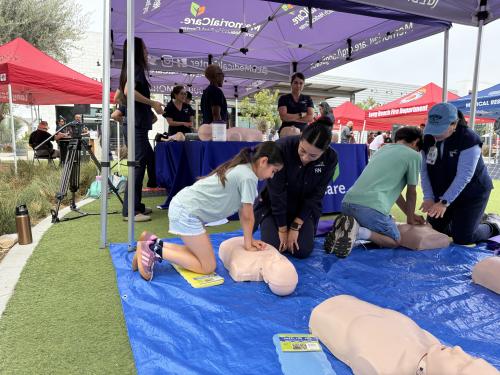
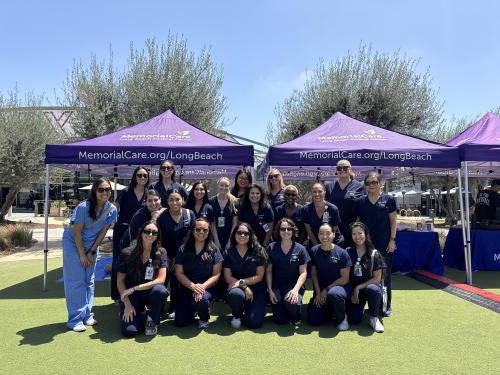
When cardiac arrest strikes, the first few minutes can mean the difference between life and death. Yet fewer than half of patients receive CPR before reaching the hospital. To help close this gap and improve survival rates in the Long Beach community, MemorialCare Long Beach Medical Center, in partnership with the Long Beach Fire Department (LBFD), hosted a free, interactive “Sidewalk CPR” training event on Friday, June 5, at Long Beach Exchange during CPR and AED Awareness Week.
Long Beach Medical Center treated nearly 170 cardiac arrest patients between July 2024 and June 2025, yet only 45% received bystander CPR before arriving at the hospital.
“This number is an improvement from 40% just two years ago, and it shows this community is learning and stepping up,” said Khiet Hoang, M.D., medical director, emergency cardiac services, MemorialCare Heart & Vascular Institute, Long Beach Medical Center. “But more than half of people in cardiac arrest still receive no help before professional responders arrive. Events like Sidewalk CPR aim to improve those rates by giving community members the skills and confidence to take immediate action and potentially save the life of a loved one, neighbor or stranger in need.”
During the event, Long Beach Medical Center nurses and LBFD firefighters led hands-only CPR demonstrations across multiple training stations. Participants practiced chest compressions on mannequins representing different body types, including adult male, female and infant models, helping reduce hesitation and build confidence in real-life emergencies.
Instructors also emphasized maintaining the correct compression rate, encouraging participants to use familiar songs such as “Stayin’ Alive,” by the Bee Gees and “Texas Hold ’Em,” by Beyonce to guide rhythm.
“Men are more likely to receive hands-only CPR than women. As a result, men have a 23% higher chance of survival compared to women,” said Nissi Suppogu, M.D., medical director, Women’s Heart Center, MemorialCare Heart & Vascular Institute, Long Beach Medical Center. “There are many reasons people hesitate to perform CPR on women. One is uncertainty about how to help, another is others fear doing something wrong, and some feel uncomfortable about touching a woman’s body during an emergency. But those few seconds of hesitation can mean the difference between life and death.”
Hands-only CPR can double or even triple a person’s chance of survival.
“Seventy percent of cardiac arrests happen at home,” added Dr. Hoang. “That means the person whose heart stops could be someone you love. When every second counts, you don’t need medical training to make a difference—you just need to know what to do and be willing to act.”
Since 2012, MemorialCare Long Beach Medical Center has educated the community about CPR through annual Sidewalk CPR events as part of its ongoing outreach efforts. Cardiac arrest remains a leading cause of death in the United States, underscoring the importance of equipping bystanders with the skills and confidence to respond in an emergency.