Published on Nov. 19, 2026
Why we need to get comfortable with the words butt, poop and talking about benefits of anal Pap smears
We talk openly about mammograms, colonoscopies and cervical Pap smears—even to complain about them. But mention an anal Pap smear, and things get uncomfortable quickly.
As a physician, my message is simple: We need to get comfortable with the uncomfortable conversations about butts.
Who Should Consider an Anal Pap Smear?
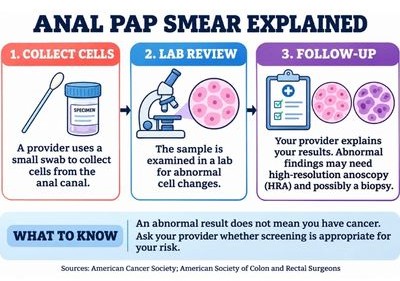
Anal cancer is relatively uncommon, but rates have been rising for many years. For people at increased risk, screening can find abnormal cellular changes before they become cancer.
The anal Pap smear works like the cervical Pap test but is much less invasive. A provider uses a soft swab, not a speculum, to collect cells from the anal canal and checks them for precancerous changes or cancer.
Most anal cancers are linked to high-risk types of human papillomavirus, or HPV. Screening focuses on higher-risk people, including certain people living with HIV, those with a history of some HPV-related precancers or cancers, and some with weakened immune systems.
If you have HPV or other high-risk criteria, ask your primary care physician or OB GYN whether an anal Pap smear is right for you.
An Abnormal Result Does Not Mean Cancer
If your Pap smear comes back abnormal, take a breath. It doesn’t mean you have anal cancer.
It means we need to take a closer look.
Your doctor may recommend additional testing, such as high-resolution anoscopy, which uses magnification to examine the anal canal and find abnormal tissue that may need a biopsy. At MemorialCare Long Beach Medical Center, we are one of just a handful hospitals in the area that offer this exam to clarify an abnormal result and guide next steps.
Taking a Closer Look with High-Resolution Anoscopy
For Whittier, Norwalk and Downey residents who need it, that exam is worth the short drive south on the 405 to Long Beach. We’re one of a few regional locations offering high-resolution anoscopy, diagnostics typically found at academic medical centers. It’s performed by a fellowship-trained, board-certified colorectal surgeon, with both biopsy and elimination of lesions possible during the same procedure.
If results show precancerous changes or cancer, you’re connected to the MemorialCare Todd Cancer Institute team, who works closely with the surgeon to take the appropriate clinical pathways.
Don’t ignore an abnormal finding or delay recommended testing. I understand why patients hesitate to bring up anal health, but to a physician, this is preventive care. Embarrassment and stigma shouldn’t keep anyone from a conversation that could protect their health.
Since most anal cancers are linked to HPV, the vaccine can lower your risk. Adults can still get it up to age 45, not only teens and young adults. If you haven’t been vaccinated, ask your doctor about it.
One uncomfortable conversation today may prevent cancer down the line.
Call (877) 696-3622 or scan to schedule an appointment.
Medically Reviewed By
Ketan Thanki, M.D., colorectal surgeon, MemorialCare Todd Cancer Institute, Long Beach Medical Center
About the Expert
Ketan K. Thanki, M.D., is a fellowship-trained, board-certified colorectal surgeon at the MemorialCare Todd Cancer Institute at Long Beach Medical Center, specializing in benign and malignant diseases of the colon, rectum and anus. His expertise includes colorectal and anal cancers, inflammatory bowel disease, pelvic floor disorders and other complex colorectal conditions.